
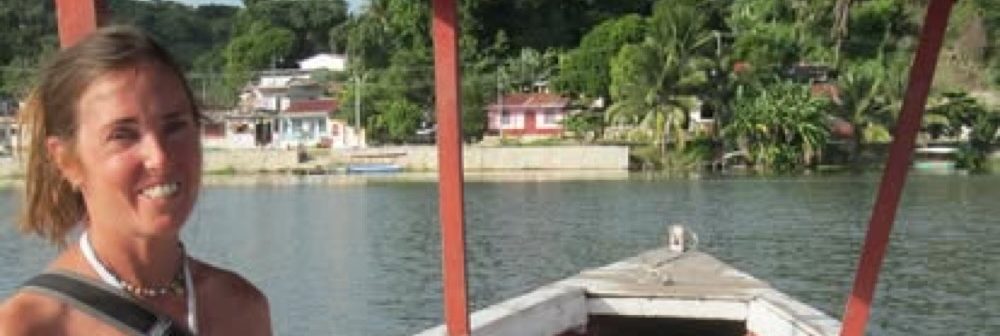
May 3, 2023. I hadn’t planned to wake at the crack of dawn, but knew I had to wake early as it could take much of the day to go a mere 117 miles. I left most of my heavy items behind at Richard’s condo with as little as possible. My knee was still very problematic after I injured it in Bocas del Toro and had to walk with a staff. I had hoped to visit Corcovado park and stay in a hostel within the park for a few days before, but after reading about the “aggressive” 30 minute trail to the place, I decided it wasn’t worth the risk and cancelled my stay. I had had my fill of slow buses. An only 25 minute car ride, the trip to David by bus took 1.5 hours. The driver seemed determined to go as slow as possible, except when someone passed and he was compelled to barrel down the hill and endanger us all just to show them.
At the terminal in David, I searched for the bus to Aurmuelles or the frontera. Cesar had family in Aurmuelles and said either bus would work. I caught the latter bus and asked the driver to let me out at Paso Canoas, the border with Costa Rica. My knee was killing me, and I was crammed in a mini van with people sitting on top of one another. I felt like a sardine being ejected from a can upon exiting, and had to negotiate with someone to give me enough leg room to keep from having stabbing pain. Within one step from the bus, I was confronted by a woman begging with children in tow. There seemed to be people lining the streets in all directions clutching their personal belongings and children. Between the people and kiosks selling trinkets and street food, I wondered whether this was a close approximation of a scene in India.
I was confused about which direction to go, and got misdirected, walking for a ways in the wrong direction. After a couple of tries, I finally found the border crossing out of Panama. They used a sophisticated fingerprint system, but because of scleroderma, two of my fingers failed the test. I explained that I had an illness that deformed my fingers, and they let me pass without any issue. The next challenge was to find Costa Rican customs. When I did, they were adamant in demanding a bus or plane ticket out of Costa Rica, even though I had an airline ticket from Panama City to the US in 10 days time. Logic would not prevail. I tried to explain but eventually the woman said she wouldn’t let me cross unless I complied immediately. I sighed and trundled down the road to the bus depot. A long wait ensued, as everyone and their grandmother was trying to get a ticket. I waited for about an hour in a queue of about 50.
When I got to the front of the queue, I was informed that I had to buy a return ticket from the capital, San Jose. A one way ticket from Palmar Norte was a mere $6, while they insisted that I buy a $39 ticket from the capital, San Jose. To add insult to injury, they didn’t take credit cards and I had little cash. And it was 95F with 90 percent humidity, and my knee was killing me. I returned to the Costa Rica customs agent with a ticket to Palmar Norte, not San Jose. A female agent who worked in the crowded office scowled and shouted that she would send me back to Panama if I didn’t cooperate. I thought for a moment and decided it wasn’t worth arguing, as they had power over me. So I went to onwardticket.com and purchased a plane ticket for $14.
They looked at my booking with suspicion for some minutes. I had visions of the slow bus back to Boquete. Finally, they stamped my passport. I asked a woman sitting nearby if there was a place I could hang out for an hour and a half until the bus left. She recommended a restaurant down the next street, where I sat and had a nice casado. It also helped that they had overhead fans, as it was 93 with 90 percent humidity. A shock to the system after an air conditioned bus. The word casado also means married, and was used to refer to a dish that a woman would have to make prior to her wedding to prove her prowess in the kitchen. While sitting there, someone came into the restaurant asking for alms.
I headed to the bus station with 15 minutes to spare. The bus was 30 minutes late. With relief I took what seemed like the only spare seat on the bus. What I didn’t know was that in Costa Rica, you are assigned a seat when you buy your ticket. I sat, blissfully unaware, until a man indicated that I was in his seat. I looked at my ticket, and sure enough, there was a seat number. But it was a window seat on the wheel well and I couldn’t sit there because of my knee. I sat in another unoccupied seat and got bumped a few times until I moved to the very back. I prayed that no one else would come, but at the next bus stop three guys did, and I asked one of them if we could switch. I told him I had been assigned seat 12. As fate would have it, someone else was in my seat, but he explained that we were switching, and they complied. Apparently it’s more common that I would have thought not to sit in one’s assigned seat. During the course of the ride, a number of other people were asked to move.
I ended up next to 3 young Venezuelan men, refugees who had decided to head north after Biden ostensibly announced the opening of the US border a week earlier. They had already made their way across Venezuela and Columbia and through the treacherous Darien Gap. Darien is a stretch of heretofore untrammeled jungle connecting Columbia and Panama, though it’s been degraded significantly, in part due to immigration. One of the young men, perhaps no more than 20, told me about the trip and showed his video of a large group of immigrants at a river in Darien. They were camping without gear: sleeping on the ground without tent or pad. I was struck by their circumstances and wondered what I would do in their shoes. I warned him that the US was a formidable, unwelcoming place for immigrants from the south. He didn’t seem to hear me.
We finally arrived in Palmar Norte where I was relieved to see Russ. He’s lived in Ojochal since the 1980s and was the first Canadian to settle there. He and his wife moved there together and have since gone separate ways but are still friends. We have become friends over the years, as we have mutual friend with whom I was in community. I desperately needed Costa Rican currency and so we headed to the local ATM to get cash. Across the street, there was a flock of scarlet macaws in a tree. It would be the only time I saw more than two macaws, and quite close to boot. I had to do the mental arithmetic to figure out currency conversion and how much I would money I would need. I had heard that Costa Rica was expensive but didn’t know how expensive. We stopped at the local market and bought some avocados from several Venezuelan refugees outside selling avocados. Russ said that this market was cheaper than the one in Ojochal, which had become an expat community and therefore unaffordable. Even here, groceries were frightfully expensive. I had sticker shock. Some items were double California Bay Area prices.

He told me a bit about life here and pointed out a few places of interest on the drive north. We unloaded groceries and he kindly gave me his bedroom to use for the week. Then we set off down the road to investigate the local waterfall. Apparently, the family whose land borders the falls now charges $5 or $10 per person to see it. What a shame. We snuck down without alerting anyone to our presence. All I wanted to do was see it, and it didn’t make sense to pay for a look. Then we headed home and I heard the first sunset toucan call of my life. I followed the distinctive call and found the bird at the top of a bare tree, perhaps 100 to 150 feet in the air. I marveled as he turned one way and then another, lowering his head in a sort of bobbing motion. He continued for 10 minutes or so before heading off, presumably to another tree to continue his honing beacon. Apparently they find (and are found by) other toucans this way.

May 4. This was my first night at Russ’s house in Ojochal. It had finally cooled off enough to sleep around 10am. I was rudely awakened by the call of a clapper rail about 2 feet from my head at 4:30am. Russ has a nesting pair of rails, and no windows (only screens), so their deafening call reverberated in my skull. We took Bruno, his aging golden retriever, to the nearby stream, where we spent a long while, maybe 30 minutes, sitting up to our necks in water, bracing our feet on a rock to keep the swift current from dragging us downstream. It was an otherworldly experience, and I felt alive and present. Ecstatic, I looked up at the multiplicity of greens in the leafy foliage. I lost myself in the tableau. When I was numb and my skin burned, I gingerly released my foothold and made my way to the shore. Bruno waited expectantly, dutiful in his obedience to Russ. Russ is good with dogs. He is definitely an alpha. We walked back to his house, changed clothes and grabbed necessities for the day, and drove down to the town grange hall where the weekly farmer’s market was in full swing. It was odd because there was no one else there but us. Russ likes to watch his pennies and does most of his grocery shopping at the market, spending about $20 a week in fruit and vegetables. I couldn’t resist the pain au chocolat, aka chocolate croissant, baked daily by a Frenchman in town. There is a significant French expat population in Ojochal.
On the way to Uvita, of the famed Playa Uvitas “whale’s tail”, we stopped at Pancito Cafe. I was hankering for a latte, and treated Russ to a latte and pastry. Again, sticker shock. $14 USD. In Uvita I inquired about the bus schedule back and purchased my ticket. Next to the bus depot was a small office where one could book tours and national park entry. We decided to purchase a ticket to Manuel Antonio, the most popular (and smallest) national park in Costa Rica for the next day and a boat tour to Isla de Cana from the Oso Peninsula on the day after. An action-packed couple of days.

I love exploring and hadn’t had access to a vehicle (or someone with one) for 5 weeks. I felt guilty asking Russ if we could check out Dominical, as he seemed reluctant to drive the additional 11 miles. He didn’t seem to like driving much, and seldom left Ojochal. I wondered whether I would be the same if I’d lived here as long as he had. Prior to 2010, the entire Pacific coast of Costa Rica from the southern border to Domincal had been dirt. And rough at that. Russ reminisced about driving it by quad. He said it was often impassable. He conceded and we drove the additional distance. I felt like a dog on a road trip, my head practically hanging out the window as I took in sights I’d never before seen. This part of Costa Rica is lush tropical jungle, the kind that I imagined covered all of Costa Rica. Turns out the rest of the country looks very different.
Dominical seemed like a tranquil surf town. It was touristy, but had a laid back, hip vibe. I saw a few barefoot surfers making their way down the dirt track, their boards under one arm. We drove to road’s end, then got out and threaded our way through a small artisanal market. Some of the handicrafts were mass-produced, but one guy was an original, making hats out of palm leaves. We heard the scream of a scarlet macaw before we saw it winging through the palms. There were about 15 people scattered along the beach, sitting or lying on the sand, preparing for what seemed like a ritual observance of sunset. I walked along the beach, looking at the water and occasionally down at my feet for shells. Russ had a bum hip and was having trouble getting around easily, so I joined him back near the car. We watched as the sun dipped below the deep blue water of the Pacific, and after a few minutes jumped back in the truck and headed home. I hoped the clapper rails would sleep in next morning so I could do the same.

May 5. Thanks to the early morning wake up call of the clapper rail, I woke up bleary-eyed and bushy-tailed at 4:30am. Russ always wakes at the crack of dawn, so at 5am he was ready to go. We took the ritual morning walk and swim with Bruno, his graying retriever. The river is about 10 minutes away, and on the way I heard a toucan. Music to my ears. After sitting in the ice cold water for 10 minutes, long enough to create a protective bubble against the heat that would last at least a few minutes. My own A/C.
Russ is very careful to drive the speed limit in Ojochal, 25 mph. While folks zoom down the road in front of him, he insists on keeping to the speed limit, as much to annoy and irritate as to impart a lesson, as anything else. The drive along the Pacific coast to the park seemed endless, as north of Dominical we ran into palm oil plantations, which stretched as far as the eye could see. I was sad to see this travesty of jungle replacement. I’d also observed on CR’s southern coast on the way to Ojochal. We finally arrived in Quepos, whose seedy side seemed more like a beach town in Belize than Costa Rica. Russ threaded his way through the town and finally made it to the park. As I opened the car door, a man started hounding us about taking a tour. He clipped our heels, telling us that without a tour, we would see nothing. I was extremely frustrated, and told him no several times, while Russ was more nuanced in his response. As a non resident, I was charged $18, while Russ was free. They told us that without a tour, we would see very little. I had a feeling that the ticket office was working with the guide who had been hounding us. We succumbed and I paid another $20 for the tour.
They told me I couldn’t bring water or food into the park. I was miffed not knowing that and left the nuts and water bottle in bushes near the entrance. On my way out, I stopped to retrieve both, only to run into a 4 foot iguana standing a foot from my goods. I wasn’t going to argue.

I was surprised to find that the park is a narrow isthmus of land, and that most animals are essentially trapped. Our guide was a biologist and he told me that genetic bottlenecking was a real problem here. He told me about plans to create a corridor of trees from the mountains to the park so that tree-travelers like sloths and monkeys could breed with other populations. It was a beautiful place. We saw an anteater way up in a tree, and I noticed that the guide mostly took photos for people. He asked the whole group (we were about 20 people) to keep eyes out for animals. Other than the anteater, we didn’t see much. A few hummingbirds, some Capuchin monkeys (more later), and a Toucan. Russ was having a lot of pain with his hip, and after the tour, told me to walk on my own. I didn’t want to make him wait and took a fast walk up the boardwalk to the highest point in the park. I came upon a Capuchin monkey who had slung his legs over the hand rail and rested his chin there. He was darling (I try not to anthropomorphize animals, having studied biology and ecology, but my inner child fell in love). Periodically, he would flip around and face the other way on the bar. A couple of tourists watched intently. What’s not to love.


I was floating on air, and so happy to be exploring this beautiful park. Eventually I met up with Russ and we walked back to the entrance along the beach, which was stunning. Most park visitors had ended up there, swimming in the beautiful blue waters.

Russ was tired, and wanted to head back home. On the way, we stopped in Dominical, a little surf town which up until a few years ago was only connected to Palmar Norte by a dirt road. Russ had a trusty pup named Bruno, a sturdy retriever, that he’d left him at home. Russ was a dog magnet though, and a stray dog started following him through the surf.

We were also in Dominical to see a children’s play that Russ had been a set designer for. I appreciated how he cared for and connected with the local community.
May 6. Today we booked a trip through Sierpe tours to Reserva Biologica Isla del Caño, stopping first to look at the mysterious round granite orbs in Palmar Sur. Archaeologists are still perplexed about their symbolism. Interestingly enough, there were several on the island we visited by boat. The whole place is an archaeological site, and guests are asked to leave everything as they found it. We were asked not to walk past a viewpoint a few minutes up from the beach.
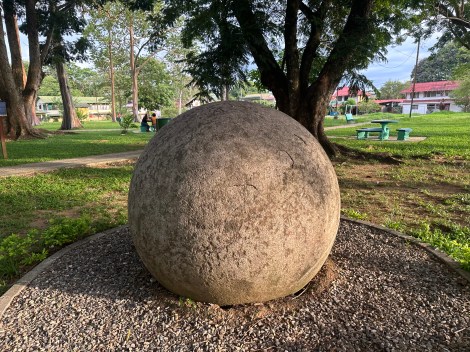
We boarded the boat on the Osa Peninsula at the Sierpe river, and started our journey. On the river delta we saw crocodiles sunning themselves, a troupe of Capuchin monkeys, a boa curled up in a tree after a big meal, and lots of birds and fish. Then we were out in the open ocean and had a 20 minute bumpy ride out to the island. When we arrived, we were greeted by a few palm trees and a wild looking shore.
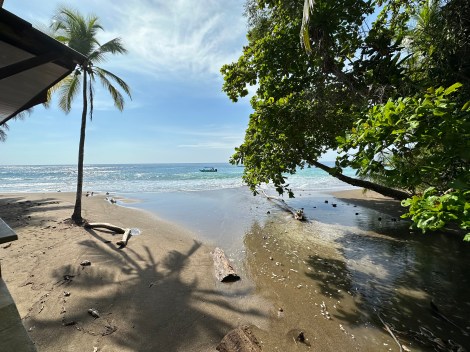

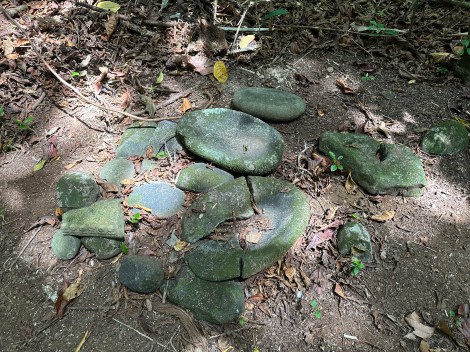
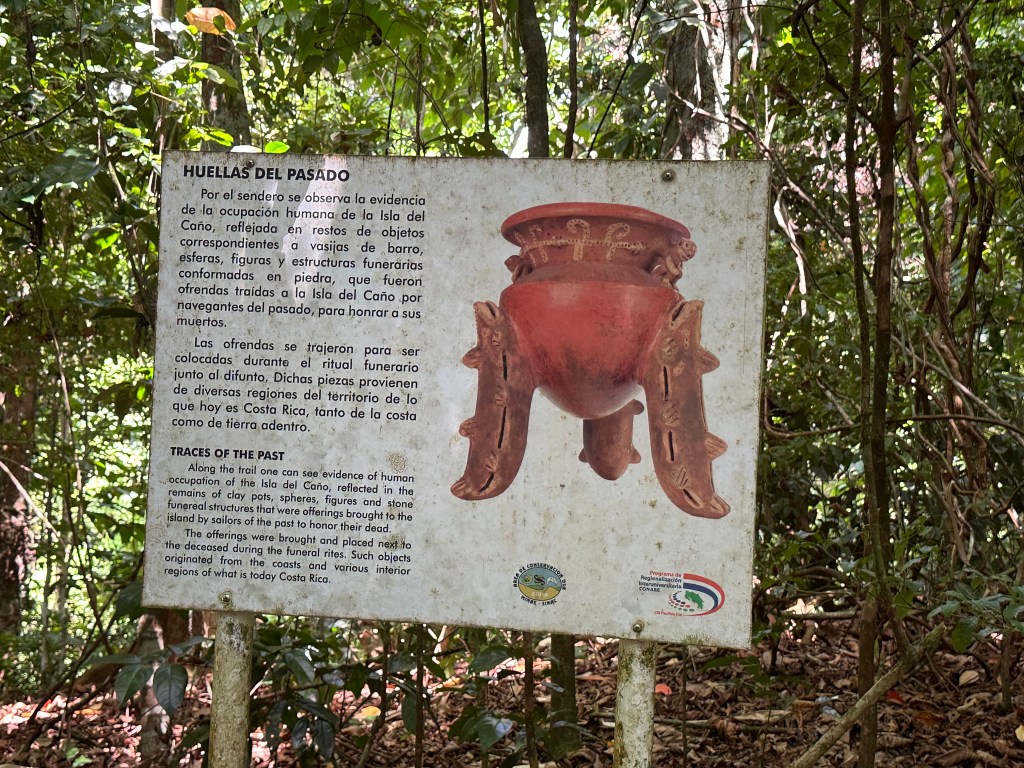
We were allowed to explore the shore and walk up to the viewpoint a few meters up the trail. Curiosity killed the cat (that’s me), so I continued up the trail for 30 minutes or so, wanting to go further but not get in trouble. I was careful not to touch or disturb anything, knowing this was an important cultural place and academic study site. It was a very special place, and I reveled in its wildness. The boat ride back was bumpy, as the island is a quite a ways from the shore in open ocean.

We were pooped by the end, and drove back to Ojochal for dinner and bed.
May 7. I wanted to explore the trails and beach at La Cusinga Lodge, a short drive north from Ojochal. Russ agreed and we headed off. He still couldn’t walk much and agreed to hang out on the veranda while I explored trails and shore. It was a beautiful spot and we got to see toucans at the end of the day eating fruit from the almendra tree.


I was blown away by the huge trees on the rainforest trail. I can’t remember their name but I felt the same as I felt looking up at the Grant Tree in Sequoia National Park. I broke up my hike in a wonderfully refreshing stream after a very sweaty hike. A few other people were also enjoying a dip. I wasn’t put off.

The shore was beautiful, and I was able to walk for miles, connecting through a jungle trail to other beaches. As I walked, thousands of crabs sought shelter, especially when I walked through the boulder field at the bottom of the trail.

It was another long day, and we headed home. I walked to the giant tree at the end of Russ’s street and looked at the very top, hoping to see the toucan who’d been calling the day before at dusk.
May 8. It was time for me to return to Boquete. I had such a lovely time with Russ, and told him I hoped to return some day. It turned out to be sooner than I expected.
 Lisa Karpinski
Hope you are well, dear Lisa!
Ed Kiefer edkiefer1@gail.com
LikeLike
thank you, Ed. I am. Are you still in botany Bay?
LikeLike
edkiefer1@gmail.com
LikeLike