
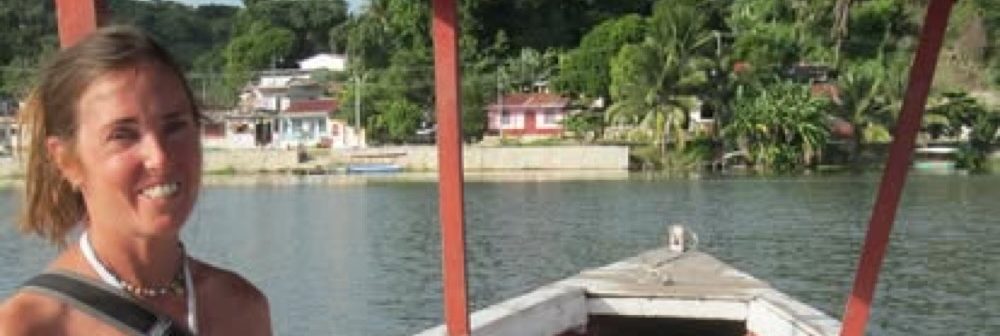
April 17, 2023, Panama. I woke at 7 and packed quickly, only to have my food bag rip as I left the apartment. I had to run back upstairs for another bag, and by then I was so late for the shuttle that I sprinted down the hill. At 8:07, a driver pulled over and offered me a ride. I gratefully accepted—lucky timing, since Maria, the owner of Hello Travel, hadn’t received my message letting her know I’d be late.
I arrived just as the drivers were loading luggage onto the top of the bus. A few packs still remained, including mine. Thank god for small favors. Maria treats her drivers well, so they lingered in the office a while, enjoying snacks and lattes. Rather than wait on the bus, I hung out with Maria and her assistant (also named Maria). I’d spent time with them before but never realized there was a coffee bar in the back of the shop. They offered me a latte, and while we chatted, Maria told me she’d been halfway through a bachelor’s in architecture when COVID hit and left her $1,000 in debt. She wants to pay it off before returning to school. I appreciated her honesty and the kindness of both Marias.
When it was time to go, I settled into the four-seat row in the back of the bus—perfect for rotating views. I changed seats every 10 or 15 minutes until the shuttle filled. At $30 for the 4.5-hour ride, it was well worth it. Much better than the public bus, where people often close the curtains and block the view. I loved watching the landscape change—from lush Boquete to the hot, dry lowlands near Gualaca, and eventually to Alto del Valle. I even saw a toucan winging overhead—my first (and only) sighting in Panama!
We passed Ngäbe people going about daily life: hanging laundry, sweeping, chasing chickens, greeting school kids. Eventually, we reached Almirante, a port town just a 25-minute speedboat ride from Isla Colón. When I saw the line for the boat, I guessed we’d wait about half an hour—and I was right. Most tourists stood in the sun with their heavy packs, but I sat down, figuring it was better to wait comfortably. Ismael, a tour operator, told me about his three tours. Later I’d find out that every tour operator offered the same three trips for the same price.
The wait ended quickly, and about 25 of us were packed onto a small boat, our luggage stowed up front. I got an ocean-side seat next to a very polite young man from Panama City who serves in the military. He even switched seats to shield me from the sea spray. As we sped across the water toward Isla Colón, we chatted. He told me about his assignments near the Costa Rican border, which made me wonder—what kind of threat does Costa Rica pose, given they have no military?
Once we landed, we said our goodbyes. I asked about heading to Isla Solarte, and the boat operator said they could take me right away. But I wanted to explore Isla Colón first, so I left my backpack and food with them and set off, feeling lighter and free.
The town was a chaotic jumble of cafés, restaurants, hotels, and tour hawkers. I’d been told to try Tom’s Restaurant for affordable local food. I remembered seeing a sign for it earlier and trusting my intuition—but I couldn’t find it. I had to wait until I was leaving Bocas del Toro to try again.
I love exploring on foot, so I wandered along the coast, leaving the noisy town behind. Like Almirante, the area was marked by poverty and trash—closed hospitals, crumbling cemeteries. At one point I asked a man if I could walk on the beach. He said yes—it’s public—and mentioned he was a Russian expat who fled a year and a half ago. I told him I couldn’t stand the “ugly American” stereotype, and he replied that there are toxic people in every country, including Russia. I appreciated his perspective.
He showed me a row of small oceanfront rentals, noting that they were quieter because they were set back from the waves. I told him I actually like the sound of waves. We said goodbye as he turned onto his lane. I knocked on a few doors, inquiring about rental prices. Most asked me to call, but one woman from Quebec quoted $39–$59 per night, depending on the view. Even at $59, the room wasn’t much.
I kept walking and eventually reached a Chinese-run market, where I bought a dumpling and a Häagen-Dazs bar for $4. At those prices, I couldn’t afford to eat here regularly. How do locals manage?
I eventually reached the fancy end of town—upscale hotels and manicured lots. One hotel charged $220 a night. For $35, I could use their pool from 8–5. Tempting.
I followed a series of humorous Burma-Shave-style signs to Skully’s Bar and Hostel. It had a beautiful pool and chill atmosphere. They offered dorm beds for $25. While I was there, a guest lit a cigarette right next to a sign saying smoking was prohibited—with a $1,000 fine. I wondered what that said about the clientele.
I continued to Playa Paunch, and suddenly the road turned to sand, transforming the vibe into tropical paradise. Beautiful beach, palm trees, pricey lodges. I chatted with a woman who had lived there for eight years and loved it. After a few miles, I was tired and flagged down a colectivo taxi back to town. It cost $3 and dropped me at the park.
I asked a couple for a restaurant recommendation—they pointed me to Tom’s again. This time, I found it, but I was seven minutes too late. I pleaded my case and the owner smiled, made an exception, and brought me fish with plantains and lemonade. The fish was a bit bony, but delicious—and at $7, a bargain. I ate quickly to avoid holding up the kitchen, then explored the rest of town and returned to the boat dock.
I caught a ride to Isla Solarte. Arriving at Bambuda Lodge, I knew instantly I didn’t fit in. About 40 twenty-somethings were in the middle of a loud drinking game. The girls looked like they were plucked from a swimsuit magazine, all in butt-floss bikinis. I couldn’t even hear the receptionist over the yelling.
I was shown to a four-person dorm and tried to escape the madness, only to realize I was trapped on a jungle island with no clear trails out. That evening, I finally discovered the jungle trail to Hospital Point—but turned back when my sandals got caked in mud.
That night I walked down to the dock to write and watch the sea. I started noticing glowing bursts in the water—bioluminescence! Gary, a local who ferries guests and gives tours, told me it was caused by shrimp. We chatted as we waited for the staff he would ferry back to Isla Colón. I liked his low-key, flexible tour style and made a mental note to contact him.
Later, I returned to the kitchen to retrieve my brownie à la mode—only to find the ice cream had melted. I asked for a fresh scoop. The staff looked irritated. I hoped they understood I didn’t want to eat soup.
Back on the pier, the hostel partiers started playing “Name That Tune.” It quickly devolved into drunken shrieking. I waited two hours, hoping they’d stop. At 1:15 AM, I gave up. I walked down and found them still singing and dancing. I said, as nicely as I could, “I’m 60 and have sleep issues. I feel like I have to leave because I can’t sleep.” One guy retorted, “In Germany we ask nicely.” I replied, “This is as nice as I get after two hours of yelling.” I gently asked if they’d move to the pool or pier so people in the rooms above could sleep. One guy agreed, and eventually, they dispersed. I felt guilty, but also desperate. I barely slept.
April 18. Today was better. I had tried the water slide when I arrived the evening before, but it was terrifying—so once was enough. There were no cooking facilities, but I did my best not to order much to save money. I had a brownie the first night, an omelet for breakfast the next morning, and then joined a jungle walk to Hospital Point. That’s where I met Brandy, a wildlife biologist who had just come from turtle research in Costa Rica and was now doing a short stint here.
She pointed out red frogs, spiders, and almost caught a snake. The hike took about an hour to cover the half mile through muddy trails. The finale was snorkeling around a small beach next to the point. It was great. I returned the next day on the same hike, this time heading for the best snorkeling spot beneath a large coconut palm. I love snorkeling—can’t get enough of it.
We passed a shack where the family has been baking coconut bread for 50 years. The first day, only the kids were around, and no bread was being made. The second day, they were baking over a wood fire in giant cauldrons. I bought a bag while it was still warm—just butter, flour, and grated coconut. The man was kind and showed me how to open a coconut, then handed it to me to drink and eat. They had a three-week-old puppy that was adorable to watch. After 30 minutes of snorkeling (not nearly enough!), we were picked up by boat and returned to the hostel. I was feeling a bit of island fever. You couldn’t get off the island without reserving a boat, and that cost.
April 19–20. Over the next few days, I had some meaningful conversations with staff. I spoke with the gardener, who owns land and a farm on the mainland. He shared the sorrow of his brother’s 20-year prison sentence for killing a woman and told me about the plants he tended. I also chatted with Melanie, a lovely local woman who asked me daily how I was sleeping after I complained about a rowdy, drunken group yelling into the night. She told me that where she lives in Old Bank, it’s often so loud she sometimes calls the police on neighbors.
Brandy, the wildlife biologist, and I connected during the jungle hikes. She’ll be here for a few months through a Workaway program, and I found it heartening to know she’s helping preserve what little wildlife is left on these fragile islands. She studied in Austin, Texas, specializing in Neotropical ecosystems, and had spent time in the Ecuadorian rainforest.
I made friends with a few travelers: Sarah and her boyfriend from Zürich; Estevan from San José, Costa Rica; Colin from Berlin; Pina, whose mom is German and dad is South African; Melanie from Alsace (now living in Podesí, Panama with her boyfriend); and a kind Dutch couple. Colin and I talked about the Pacific Crest Trail and his own recent four-month trip through Argentina, Ecuador, and Colombia. He studies Spanish weekly back in Berlin and said it’s become a vital social lifeline.
I tried to limit my food spending at the Lodge, where meals were pricey—just one breakfast, one dinner, and one dessert. I snorkeled off the pier, looking for starfish and coral, and took the kayak out a few times—once left toward the coral patch, and twice to the far end of the island. The kayaking was a highlight, and I wanted to tell my friend Mike about it. Kayaks and snorkeling gear were free here—unlike Selina Red Frog or Palmar—and I was grateful.
April 21. I loved staying at Bambuda Lodge and was sad to leave. Melanie, Veera, and I took a noon boat to Isla Bastimentos, paying $8 each instead of $16 thanks to splitting the cost. I stayed at Selina Red Frog, while they headed to Palmar. I doubted my decision initially—everyone else went to Palmar—but later I decided Selina was better: it had a kitchen, A/C in the dorms, and four-person rooms instead of eight. Plus, I loved the staff and activities like meditation, stretching, and night hikes with a biologist.
It was a peaceful time. I enjoyed not having an agenda and finally slept well after the first night. My bed was in a corner without windows, and the rooms didn’t have A/C, but I was adjusting to dorm life and appreciated the savings—under $30 a night versus over $100 for a private room.
April 22. I had booked two nights at Selina and two at Palmar, unsure which I’d prefer. I packed up around 9:30 a.m. and dropped my bag in Palmar’s storage locker. Check-in is usually mid-afternoon, so they wouldn’t let me access the room. A female receptionist at Selina had kindly let me store food in their kitchen—a real money-saver. I cooked at Selina while staying at Palmar and only occasionally ate at Palmar’s pricey restaurant.
I loved meeting Tomer, Selina’s resident wildlife biologist, who had previously worked for 10 years elsewhere. He arrived here by catamaran with his parents, who’ve been sailing around the world. I also got to know Orian, the yoga instructor. I initially found her aloof, but later appreciated her language skills—fluent in Spanish, Hebrew, and English. We connected after a manifestation class and had a touching conversation about my healing journey. We hugged and, though we didn’t talk again, I felt close to her after that.
April 23. I spent time exploring Isla Bastimentos. My first day, I walked Red Frog Beach to Wizard Beach and tried to reach Polo Beach for snorkeling but ended up wandering a nature trail through the upscale Red Frog Resort complex. It felt oddly deserted. I passed the zip-lining area and spotted a bat and several parrot species—though Tomer insisted there was only one kind on the island.
At Polo Beach at sunset, I decided it was too dark to snorkel, so I returned to Selina for dinner—tuna and leftovers—and went to bed early. I was still recovering from heat-induced exhaustion at Bambuda.
April 24. A noisy dormmate woke me around 6 a.m. rummaging through her things. I eventually headed to Polo Beach with rented snorkeling gear and ran into Vanessa, a Filipina volunteer from Palmar. We met at a bonfire she hosted while I was staying at Selina. She was warm and welcoming, offering me marshmallows even though I wasn’t technically a guest. We talked about the Philippines and her plans to visit her sister. There was also a guy warming his hands by the fire, listening to Tibetan monk chants. A curious crowd.
April 25. Back to Polo Beach. I was told the best snorkeling was near Polo’s shack. Polo, in his 80s, still lives on his disputed land, despite a wealthy Kiwi who had purchased it. Apparently, the Panamanian courts sided with Polo. He was sitting outside, clearly drunk, and offered me a Coco Loco—rum in a coconut—which I declined. I didn’t want to drown while snorkeling.
A young Panamanian-Nicaraguan couple were with him, selling coconuts. They’d lived in Tacoma and couldn’t wait to return to Panama. The man joked he was Polo’s son (he’s not). I bought a fermented coconut—yuck—and left it on the beach. By the time I got back from snorkeling, ants had claimed it.
The snorkeling was mediocre and the shallow coral reef made it a challenge. I’m always on alert for moray eels. Coral here grows in just 1–2 feet of water, so one misstep could damage it—or injure you.
April 26. I was back at Selina for my final two nights. I was excited to return to Zapatilla. Chop, the boat captain, and his assistant Juan were welcoming and warm. Chop took us to a different snorkel spot this time, after our walk around Zapatilla. I spent two hours snorkeling near two rocky outcrops. No sharks this time, but an abundance of fish. One school—over a hundred flashing silver and blue—moved like a kaleidoscope. It was magical.
Later, near Isla Coral, I saw more coral than I’ve ever seen—brilliant reds, blues, yellows, and greens, in every shape from fans and brains to bowling balls. I was the last one out of the water.
We stopped at a mangrove island and saw colorful starfish in just two feet of water. On the way back, we looked for dolphins, but didn’t find any. I asked Chop to drop me at Old Bank so I could hike back via Wizard and Red Frog Beach.
As I disembarked, my left knee suddenly gave out. I hobbled through Old Bank using a branch as a walking stick. The town was lively—houses on stilts, people chatting, kids running, and trash in the water. A young man warned me the trail to Wizard was dangerous at dusk, but kindly walked me partway and pointed out the hidden path.
I passed a bamboo evangelical church with people singing outside, and the impressive housing for the homeless, about 100 well-built homes. After a slow and labored slog, I finally made it to Wizard Beach, and back through the trash-strewn jungle to Red Frog Beach before sunset. I talked to a guy from Oregon at Palmar, then made my way up the trail to Selina, running into Tomer’s night hike group.
April 27. I revisited Polo Beach but again found the snorkeling underwhelming. Boats zoomed close to shore, likely damaging the coral. Tomer was critical of locals dumping waste into the sea, but I wonder: what can you expect when people are so impoverished? It’s hard to care for the environment when you’re barely surviving. Traveling without contributing to real change felt increasingly uncomfortable. I’ve helped individuals on this trip, but it doesn’t feel like enough.
April 28. I returned to Zapatilla, determined to end the trip with beauty. My boat friends Chop and Juan welcomed me aboard and brought us to a different, but equally amazing, coral site near Isla Coral. I spent hours snorkeling, awed by the coral and the flickering light. I didn’t eat at the restaurant this time, but asked for a single plantain and was given three—for free. These were indigenous friends of Chop, and I felt a deep warmth from them.
April 29. This was my last day. I packed and felt a little lost. No goodbyes, just drifted down to the dock. Someone kindly carried our backpacks—a generous gesture. Back on Isla Colón, I struggled to find the right boat company, but eventually located it and gratefully dropped my gear.
I treated myself at Café Amaretto. The cappuccino was perfect and the waffle decadent. I’d hoped to visit a beach, but with my bum knee, I just read and relaxed. Locals on the boat back helped make room for me, yet another act of kindness I’d experienced so often here.
The shuttle back to Boquete was uneventful. I saw my only toucan of the trip—just a flash before it vanished. I later learned the road was blockaded for four hours the next day by indigenous groups demanding representation.That seems to be the only way the government listens. When we arrived in Boquete at 5 p.m., I found the younger María and paid for the latte she’d made me the morning I left. A small circle completed.
 Lisa Karpinski