
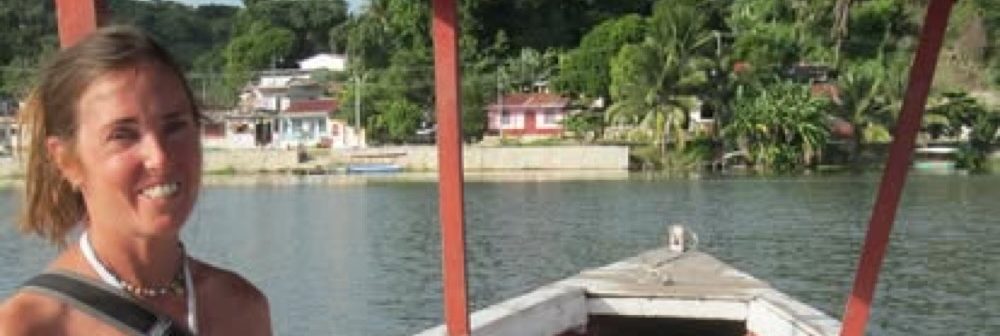
September 29, 2023, Costa Rica. What a glorious day. I drove back up the steep hill toward Palmar Norte, stopping at the top to take in the view of the Golfo Dulce. I love the Osa. It’s definitely a place I’d like to spend more time. Rain returned as I drove, but the lushness of the jungle more than made up for it. In Palmar, I thought about stopping at the ATM Russ and I had used before—but there were about 30 people in line. I drove past, then realized a moment later they were probably Venezuelans asking for help. They had been stationed next to the ATM in Uvita, too.
I’d wanted to visit Boruca, the indigenous village known for its carved wooden masks—diablos sucios and wild animals—but I was feeling pressed for time. I admired the winding road and the river far below. On one side, the vegetation remained wild; on the other, the mountains looked clear-cut for cattle. As I crossed the bridge over the Río Curré, I wondered whether its name had anything to do with curar, “to heal.”
There was a sign for a sitio arqueológico in an indigenous village, so I pulled over to explore. I haven’t seen many archaeological sites in Costa Rica—just Isla Caño and the mysterious stone spheres near Palmar Sur. But once again, my nemesis—a dog—barked and blocked the way. Apparently, there were remains in the ravine (quebrada) below, but I was too afraid to check them out.
I had also seen a sign for artisanal crafts and walked over, accidentally interrupting a large group sitting together on a back porch. They looked so relaxed and connected. I thought how healing it might be for isolated Americans to experience a village like this.
Inside a humble shack that served as a local art space, I stumbled into an interview with a brother and sister who had learned gourd carving from their mother. I tried to be unobtrusive and listen. A few minutes in, they asked if I wanted to buy something. I said I was listening.
The brother spoke softly about what he was drawn to carve, though I couldn’t quite catch everything. The interview would eventually be part of a national compendium of Indigenous voices. It might take a year or more to complete.
His sister spoke more clearly. She said when they first started, they earned just pennies. Their carvings put food on the table. She mentioned blood and tears. Their mother was patient and taught them how to carve. She loved geometric shapes, especially those inspired by the leaves of trees in their village. When they asked again if I wanted to buy something, I agreed.
I’d considered a small gourd with a jaguar or toucan, but I kept coming back to one with powerful symbolism—one the brother had tried to explain. It showed an older woman carving a gourd—his mother—beside a bird, representing the sacred twilight hour when birds call. There was a snake and jaguar, perhaps symbolizing danger, as well as a toucan and hummingbird.
I wished I had understood his explanation more clearly and seriously considered returning the next day to ask. The sister had said people often remarked on a sense of peace when entering the space. She believed it came from the peaceful energy her mother infused in the carvings. I told her it was an honor to buy the piece and asked whether they were sure they wanted to sell it—it felt like it belonged in a museum. She said it was similar to one currently on exhibit, perhaps linked to the interview.
I tucked my treasure into a paper bag and left reluctantly, feeling deeply connected to the village. Outside, one of their brothers sat by my car and told me about a nearby museum. I drove—rather than walked—for fear of being harassed by dogs. The museum was closed, but I peeked through the bamboo slats and took some photos. The interior was mostly hand-painted murals.
Next door, a young man was locking the gate of the Indigenous school. We chatted. He told me about a larger museum in the Boruca village farther up the mountain. He also shared his dream of visiting the U.S. I said it was hard to get a visa, but he proudly told me he already had one. His sincerity moved me.
Taking his advice, I started driving up the dirt road toward Boruca. They’re known for their colorful devil and animal masks and the multi-day Diablo Sucio festival in October. Russ once went and said it was dramatic. But the road was long—seven miles—and it was already 4:30. I figured the museum would be closed and turned back.
I continued along the two-lane highway, eventually turning off when I saw a sign for Parque Amistad. I’d been admiring the mountain corridor along the right and wanted to explore. I ended up in an uninspiring town called Potrero Grande (Big Pasture), which looked the part: trees cleared, horses, and a handful of people on horseback. I prefer trees, so I turned back toward the mountain crest.
By now it was getting dark, and I was exhausted. I thought about asking someone where I could camp but kept going until I reached Restaurante Nisi Rohi and met Danilo—a kind man. He offered me a spot to camp out front, but when two big trucks roared by using Jake brakes, I changed my mind. He suggested a quieter spot in El Valle.
The road was only 3 miles, but it took 20 minutes to drive—typical Costa Rican dirt road. I set up my tent by the river and went to wash. As I gingerly dipped my feet in, huge raindrops began to fall. By the time I got back and threw the rainfly over the tent, everything was soaked. I spent half the night trying to dry out my sleeping bag, jacket, and wipe sand off everything. Torture.
September 30. I woke around 5:30 a.m. to rising warmth and light after a very soggy night. I spent some time drying out my gear. My tent fly was drenched. Then I looked up and realized I’d been sleeping beneath a massive Ceibo tree—the only one for miles. José Eduardo, the baker in La Palma, had told me how Ticos used to cut them down for wood. A tragedy. These are the giants of the forest.
Nearby, I heard a toucan calling. I left the car running and followed the sound, spotting it high in a tree, its back to me. It moved its head as it called, the way they do. I love toucans—even if they eat the young of other birds.
I headed back up the steep road to Restaurante Nisi Rohi. Danilo, who’d helped me the night before, was there again. He delivers food by Uber Eats within a 2km radius, and had kindly offered me their lawn to camp on. I told him the truck noise was too much, but thanked him again.
I asked about his uncle’s coffee and ordered breakfast—gallo pinto with an egg and tortillas. I only had U.S. dollars and asked if that was okay. He said yes. While hanging my gear to dry, a local man approached slowly and asked if I was traveling alone. I said yes. He looked concerned. I told him I had friends, and he assumed I meant locals, telling me where he lived. Apparently, he owns much of the surrounding land and has trouble selling lots. He sold the parcel where the restaurant now stands 13 years ago.
Another man passed by and asked about my trip. He seemed warm and funny. I told him where I was headed and thought he asked if he could join. I said I didn’t have room—then laughed when I realized he’d said Que Dios la acompañe—“May God go with you.” I’d heard the phrase often, especially from Machita. I laughed again when he replied, “It won’t take much space.”
I packed up and drove toward San Vito to a café called T&Coffee—the only place for miles with cappuccino. It was quite good, especially the espresso. I paired it with lemon cheesecake and walked around town, checking out the window displays—clothes straight out of the 1950s. It was Saturday morning and the square was full of people. I learned that Italian farmers had helped found the area. I wondered if they planted or picked the local coffee.
Heading downhill, I passed a few slow-moving cars and was relieved not to be stuck behind a truck. The views into the valley were spectacular, though clouds loomed. Occasionally rain fell. I thought about returning to Curré to ask about the symbols on the gourd I’d bought—but once I hit the main road, I kept going toward Amber’s eco-village in San Gerardo de Rivas.
The weather turned dramatic—heavy rain, low visibility. I drove past endless pineapple fields stamped with Del Montesigns. One had a slogan: Peace in labor. I wondered if that was code for anti-union policies.
I stopped at a bus-turned-ice cream stand called Parada de Helado and had a sundae—my first of the trip. Chocolate-orange ice cream. Strange, but edible.
From there, I wound up the narrow dirt road past Rivas and tiny coffee villages toward Chirripó, where I’d hoped to hike. The road became increasingly steep and narrow. I passed some polluting trucks struggling with the incline and decided to turn back when I reached the river crossing at La Piedra. I snapped a few photos and made my way to Machita and Eli’s, where I’d stayed a week earlier. I was tired of camping in the rain and needed a dry place. Unfortunately, a truck blocked the road, and it took two hours to go 30 miles. I arrived completely wiped out.
October 1. I didn’t sleep well. Guests came for dinner around 7:30, and Ma, Eli, and the girls stayed up until 11. It felt like the middle of the night. Two of the granddaughters stayed over, and at 6 a.m., I was jolted awake by their squeals.
I started organizing my things to leave but ended up working on my blog until about 10. Then we had breakfast together—scrambled eggs with onions on homemade tortillas, their usual fare. I gave Ma a big hug goodbye. She was expecting lunch guests, and I hoped they’d show. Money’s tight.
I hit the road for El Mosaico in Cartago, a fancy café reputed to have good cappuccino. Driving through town was tough—drivers here can be remarkably rude.
 Lisa Karpinski