
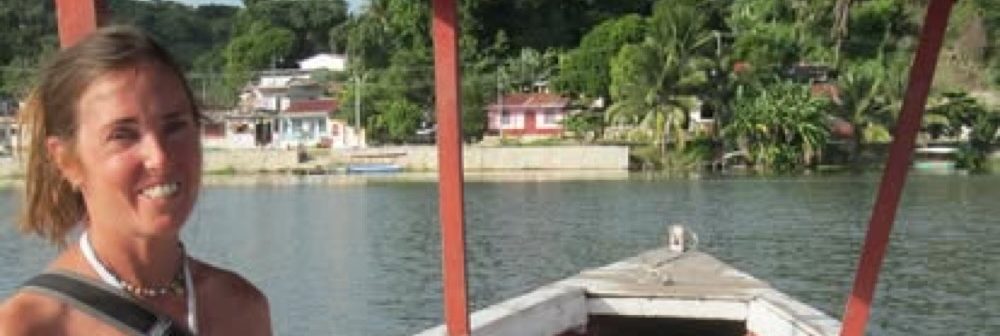
April 29 – May 2, 2023, Panama. I had hurt my knee in Bocas del Toro and was worried I wouldn’t be able to continue with the trip. It had been getting worse by the day and I decided to call Dr Goranson, the orthopedic surgeon who had previously repaired both my rotator cuffs. Based on my symptoms, he said I probably tore my meniscus and should stay off it to see if it would heal on its own. I could barely walk, which felt like being in prison. Determined not to be imprisoned, I limped the mile to the artisanal market, an overwhelming array of local and imported crafts.
As I checked out a few stalls, staying outside so as not to give false hope to the vendors, I met María López. She turned out to be a lovely woman who had grown up in Boquete. I marveled at her loyalty to the wealthy shop owner who paid pennies. Apparently, the woman owned stores all over Panama, and yet María felt compelled to work for almost no wage. She told me that during Covid, she had decided to sell used clothes out of her home, doing better than when working here.
She told me how her grandmother had died at very young, and her grandfather had been crushed by a tree. Miraculously he had survived and remained vigorous until his death at 97. He had had a respiratory ailment and ended up in the hospital a year ago. Tears streamed as she told me how he died after only 20 days. Apparently the hospital staff didn’t allow him to take his heart medicine. Suddenly I too was crying, feeling empathy for her loss and thinking of my dad who was initially misdiagnosed and died at 74 of stomach cancer.
Over the next few weeks of my stay in expat paradise, I visited María often, and after hearing how her boss was taking advantage of her loyalty and deep Christian faith, encouraged her to leave her job. She told me that she didn’t see her mom much even though she lived with her. She wanted to spend more time as this seemed like the last of her years. She felt like time was ticking away and that something might happen to her mom, just like it had to her grandparents. I bought a few things from María, including two alpaca sweaters, as I thought perhaps she would get a commission. Afterward she told me she only made $20 for 12 hours work, less than the minimum wage of $2.22 per hour.
Same old story: the rich taking advantage of the poor. During my stay in Boquete, I learned about an online magazine called international living. In the early 1990s, they had made the inflated claim that Boquete was the fourth best place in the world for Americans to retire. Prior to their announcement, they had purchased the lion’s share of land once owned by impoverished locals. These families had sold for a pittance, hoping that the little bit of money would help them get ahead. Since then Boquete has experienced a gringo invasion, and most local families have been forced to move away, often to David, the hottest city in Panama. International living sells the land at a great profit to wealthy gringos, who build expensive homes and then flip them for an even larger profit. In this way they created a kind of pyramid scheme where gringos enrich themselves at the expense of locals trying to survive.
One day Richard, my benefactor who was letting me stay at his place, asked me to show him the quiet abandoned coffee farm where birds congregate at dusk. I brought him to Buckle Tip, the gringo cafe hangout. I’d been told they made the best cappuccino in town. Their espresso was great, but the place was small, hot, and noisy, within earshot of incessant honking. Richard wasn’t impressed.
We entered the overgrown coffee farm and immediately stumbled on what was probably a homeless encampment. I stepped in poop, possibly human, and was hesitant to push on. Richard wanted to explore further, so we continued on a small trail through banana plants into yet another encampment, this time full of trash and liquor bottles. Eventually we found our way out. We heard bird calls emanating from a few of the large native trees. Boquete was no only overrun with gringos. It had also beeninvaded by non-native plants. Probably not surprising given the loss of indigenous land rights.
One day I went back to the artisanal market, where I hoped to find a representation of a quetzal. I have a tendency to buy all things artisanal, and am often carrying more crafts than clothes at the end of my stay. It seemed that the market was full of imported goods, not locally made. I found a beautiful beaded bird, and later during my stay, hiked to the sendero de las quetzales, and was lucky enough to see a pair for an instant. It was one of the highlights of my trip.
As I walked through the market, I noticed a woman wearing what looked like traditional dress. I spoke with her and found out she was an indigenous Ecuadoran. I was struck by her gold leaf necklace of glass beads, delicate gold earrings, and coral bracelets. I asked whether she sold this beautiful jewelry, and she said no, that neither Panamanians nor foreign tourists were interested in such finery. I decided to buy a llama made from thick yarn wound around a wire frame carrying a colorful basket of eggs.
I kept an eye out hoping to help María find a better job. At the Tuesday Market, the gringo expat market, I had met Amandine, a lovely Frenchman who made delectable French pastries. I found out he was looking for someone to clean his cabanas for $5 per hour. I told Maria, but she declined out of loyalty to an undeserving boss. Working hard for little money seemed the fate of most Boqueteños.
I wanted to help but didn’t know what I could do, as I would be leaving soon to return to the US for meniscus surgery. I decided to leave for a couple of days for Costa Rica to visit my friend Russ. I had hoped to take a knee brace that I’d ordered, but decided to leave without it the next day.
 Lisa Karpinski
I remember you from Camp Unalayee!?
Ed Kiefer, in Australia
edkiefer1@gmail.com
LikeLike